
How Horses Walk and Navigate Obstacles: Building Confidence from the Ground Up
Hello fellow equestrians. That sudden trip on smooth ground or that stubborn refusal at a simple pole can send your mind racing to vet bills and safety fears. I know that jolt of concern-it’s the same one I felt when Luna once spooked at her own shadow on a trail.
Let’s replace that worry with practical knowledge. We’ll explore the mechanics and mindset behind your horse’s movement.
Here’s what we’ll cover to help you and your horse move forward with trust:
- We’ll break down the four-beat rhythm of the walk and why proper hoof placement is everything.
- You’ll see how a horse’s unique vision directly affects how they judge a ditch or a bridge.
- I’ll share my step-by-step methods for introducing obstacles using patience and positive reinforcement.
- You’ll learn to spot the subtle signs of pain or imbalance that can make navigation a struggle.
My advice is forged from years of barn management and training, working with the food-motivated cunning of Pipin to the sensitive nature of Luna, always advocating for the horse’s comfort first.
The Rhythms of Motion: Understanding Horse Gaits
What is a Gait in Simple Terms?
Think of a gait as your horse’s signature footfall pattern, the specific order their hooves hit the ground. It’s the fundamental rhythm of their movement, much like your own walk, jog, or run. I often watch Pipin the pony bustle around his paddock; his quick, shuffling walk has a different pattern than Luna’s long-legged, fluid one. Don’t mix up “gait” with “pace” or “stride.” Pace refers to speed, while stride is the distance covered in one full cycle of a gait. Understanding this difference helps you diagnose lameness or simply appreciate the mechanics of that wonderful thud of hooves.
The Four-Beat Foundation: The Walk
The walk is a steady, four-beat rhythm where each hoof lifts and lands independently. It’s the gait of contemplation and digestion, the one I see Rusty using for hours on the trail. This gait is a non-negotiable part of equine welfare, as its gentle motion massages the gut and promotes feed digestion. Here’s the precise sequence:
- Left hind hoof
- Left front hoof
- Right hind hoof
- Right front hoof
You’ll hear a steady, one-two-three-four beat. Ensuring your horse gets ample turnout time to walk freely is one of the best things you can do for their mind and body.
Faster Gears: The Trot and Canter
When a horse moves up from a walk, balance and energy shift dramatically. The trot is a two-beat, diagonal gait where the left front and right hind move together, then the right front and left hind. It’s springy and requires more collection. Luna’s trot is all powerful suspension, like she’s pushing off the earth. The canter is a three-beat gait with a moment of suspension; think “left hind, right hind and left front together, then right front” for a lead. These gaits demand more from the horse’s core and require a balanced rider to avoid throwing them off their natural rhythm. Unlike the restorative walk, they are gears for covering ground or working muscles.
Inside the Step: Biomechanics of the Walk
The Symphony of Muscle Groups
A single walking stride is a full-body endeavor. I’ve felt it while hand-walking horses on cold mornings, the subtle play of muscle under my hand. Major players include the hindquarters for propulsion, the long back muscles for flexion and extension, and the shoulder group for reach. As the leg swings forward, muscles flex; as it bears weight and pushes off, they extend. This constant stretching and contracting is why a proper, relaxed walk is better conditioning than you might think, keeping everything supple without concussion.
- Hindquarters (gluteals, hamstrings): The engine.
- Longissimus dorsi (back): Stabilizes and flexes.
- Brachiocephalicus (neck/shoulder): Lifts and advances the foreleg.
- Abdominal muscles: Support the topline and engage the core.
Hoof Mechanics and Weight Distribution
Watch closely as a hoof meets the ground: it should land heel-first, then roll smoothly forward to the toe before lifting off. The most critical instant is when the horse’s entire weight balances on a single leg during the stride, a test of soundness and hoof integrity. I check for this every time I pick feet, feeling for heat or watching for a hesitant landing. Proper placement is quiet and confident.
- The hoof lands level or slightly heel-first, not toe-first.
- The leg remains straight under the body, not winging in or out.
- You hear a clear, solid “thud” with each step, not a scuff or slap.
- The horse maintains a steady rhythm without hesitation.
The Role of Head and Neck Carriage
A horse’s head and neck are their natural balancing pole. With each step, the head nods slightly forward as the front leg extends, then back as weight shifts. This innate movement is why forced, rigid head carriage in riding can disrupt their entire biomechanics and cause tension. In their natural grazing posture, the neck extends low and forward, which opens the shoulder and frees the back. My approach in the saddle is to emulate that freedom, allowing soft, rhythmic movement for balance. It’s a cornerstone of gentle horsemanship-working with their physics, not against them.
The Horse’s Toolkit: Senses for Navigation
Vision: What Your Horse Actually Sees
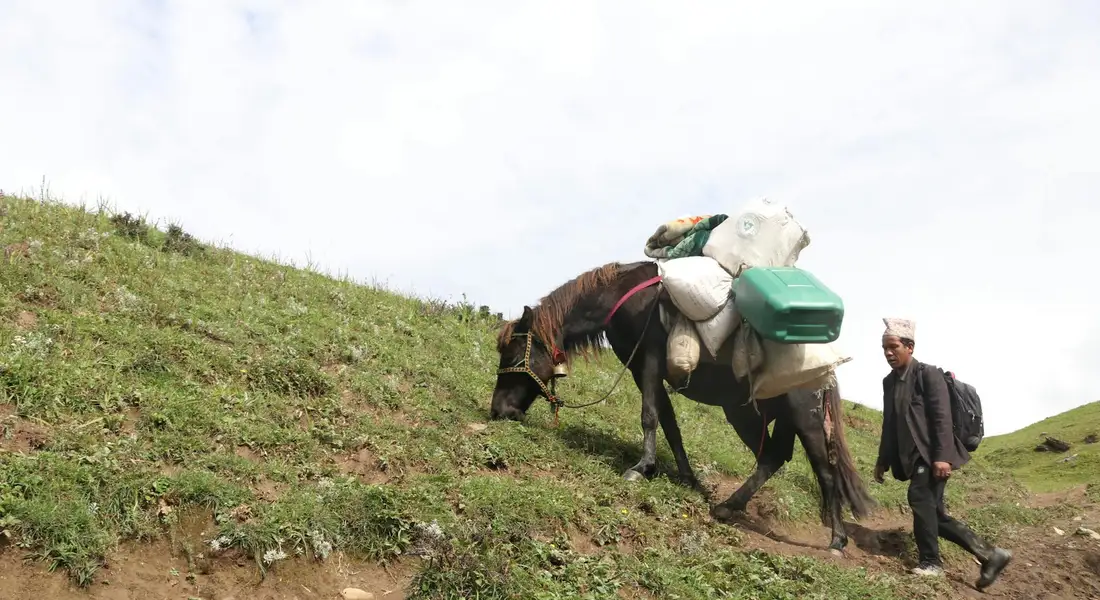
Your horse’s eyes are on the sides of its head, giving it a panoramic view of the world. This setup creates two types of vision: monocular and binocular. Monocular vision means each eye sees a separate, wide-angle picture, perfect for spotting a coyote in the brush. Binocular vision is where the fields from both eyes overlap straight ahead, providing depth perception. However, this overlap is narrower than many believe, like your horse is wearing permanent, gentle blinkers.
Directly in front of their nose and for a short distance behind them are complete blind spots. This is why a horse will often swing its head up or to the side when you ask it to step over a log; it’s trying to get that obstacle into a visual field where it can judge it properly. I learned this the hard way with Pipin, our Shetland pony. He’d stop dead at a ground pole, and I’d get frustrated until I realized he simply couldn’t see it until he was right on top of it, a fact that’s important especially when considering how horses perceive colors and contrasts.
The Sixth Sense: Proprioception and Balance
Proprioception is your horse’s innate sense of where its body and limbs are in space without having to look. It’s the muscle memory that lets you touch your nose with your eyes closed. For a horse, this is everything for safe navigation.
This internal map allows a horse to place a hoof precisely on a rocky trail or tuck its legs neatly over a fence. You can build this body awareness through careful ground work, asking for deliberate foot placements over poles and cavaletti. Luna, my sensitive Thoroughbred, transformed from a trippy yearling to a graceful mover through consistent proprioceptive training. It built her confidence from the ground up.
Trusting the Feel: Tactile and Auditory Cues
When vision has limits, feel and sound take over. Those long whiskers on your horse’s muzzle aren’t just for show; they are precise sensors, like feline whiskers, that gauge distance and texture. Trimming them dulls an important tool.
The skin is incredibly sensitive, feeling the shift of a saddle pad or the lightest brush of a rider’s leg. And they listen. The thud of a hoof on hard dirt versus the quiet sink into deep sand gives instant feedback. A horse navigating a dark trailer or a muddy creek bed is relying heavily on these tactile and auditory signals to move safely.
Approaching the Unknown: How Horses Handle Obstacles
The Decision to Engage: Reading the Approach
Watching a horse size up a challenge is a lesson in deliberate thought. The process isn’t automatic; it’s a calculated series of steps.
- Seeing: They spot the object, often with a head raise or ear flick.
- Assessing: Is it solid? Will it move? Is it a puddle (Rusty’s arch-nemesis) or a shadow?
- Adjusting: Their stride shortens or lengthens, their rhythm changes, gathering balance.
Your role as a confident, breathing anchor is paramount here; your horse is deciding if you are a partner worth trusting with this puzzle. A tense rider telegraphs doubt, while a soft seat and steady rein say, “I’ve seen this, we’re okay.”
Judging Distance for a Jump or Step-Over
That narrow band of binocular vision is critical for depth perception, but it’s not perfect. Experience fills in the gaps. A seasoned horse like Rusty has a mental library of distances. He knows the feel of the take-off spot for a two-foot log.
A green horse has no database. They may take off too early or too late, not from disobedience, but from a simple lack of visual information. This is why repetitive, low-key gymnastic work over ground poles is non-negotiable for youngsters; it builds that spatial library in a safe way.
The Physical Act of Negotiation
Once committed, the body executes a finely tuned maneuver. For a jump, it’s the bascule-the arc of the body over the fence. For a ditch or stream crossing, it’s a calculated step, feeling for footing.
- Balance: The hindquarters must be engaged to propel and lift.
- Impulsion: Steady, forward energy, not speed, is the engine.
- Rider Influence: A still, following rider allows the horse to use its back. A interfering one throws the whole system off.
I think of Pipin hopping over a fallen branch in the paddock: a little coil, a spring, and a clean landing, all done with a cheeky look back to see if I was watching. It’s a perfect, self-taught demonstration of equine athletic intelligence.
Care Through Movement: Practical Applications for Owners
Groundwork Exercises to Improve Coordination
Think of groundwork as a conversation without words, where you build a shared language of trust with your horse. I start every session with my horses by simply observing how they move freely; this tells me more about their mood and muscle memory than any textbook ever could. Simple exercises done consistently can transform a clumsy or hesitant mover into a confident partner.
Provide step-by-step instructions for simple exercises like pole work and backing up. Focus on building trust and body awareness.
For pole work, you don’t need a fancy arena. I use three or four standard poles laid flat on safe, level ground.
- Lead your horse in hand at a calm walk, approaching the poles from the side so they can see them clearly. Let them sniff and investigate.
- Walk over the first pole yourself, encouraging your horse to follow with a loose lead rope and a calm voice. The goal isn’t height, but careful foot placement.
- Once they’re comfortable, space the poles about 2.5 to 3 feet apart for a walking horse. This distance encourages them to lift their feet and think about their stride.
- Practice in both directions. Watch how your horse negotiates the space-does they drag a toe? Hesitate? This is valuable body awareness data for both of you.
Backing up is another powerful tool. Teaching a horse to back up softly from light pressure on the chest teaches them to shift their weight onto their hindquarters, which is the engine for all movement. Stand facing your horse, apply gentle, rhythmic pressure with your fingertips on their chest, and release instantly the moment they even think about shifting weight backward. With my pony Pipin, this was a game of patience that turned into a party trick of precise steps.
How Saddle Fit Affects Gait and Comfort
A saddle is the interface between you and your horse’s dynamic musculoskeletal system. When it fits poorly, it’s like trying to run a marathon in shoes that are two sizes too small. A saddle that pinches or bridges will immediately shut down a horse’s desire to move freely, shortening their stride and stiffening their back. You’ll feel it as a lack of impulsion or a general sense of resistance.
List signs of a poor-fitting saddle during movement (e.g., shortened stride, reluctance). Connect saddle balance to muscle function.
- A visible shortening of the stride, especially in the hind legs, as if the horse is walking on eggshells.
- Reluctance to move forward freely, or frequent tail swishing and pinned ears under saddle that weren’t there on the ground.
- Uneven sweat patterns after riding, with dry spots under the pommel or cantle indicating pressure points.
- A hollowing of the back or dipping away from the saddle’s pressure when you first mount.
- Developing muscle atrophy, or “dips,” behind the withers where the saddle sits, a clear sign of long-term interference.
Saddle balance is everything. A saddle that tips you forward or backward forces your horse to constantly brace and compensate, wasting energy and creating soreness in places like the loin and shoulders. I learned this the hard way with Luna; her sensitive nature meant a slight imbalance made her gaits feel choppy and tense until we found the right fit.
Spotting Early Signs of Lameness or Discomfort
Catching a problem at the walk, before it becomes a head-bobbing trot, is the hallmark of a proactive owner. Make a habit of watching your horse walk toward you and away from you on a hard, flat surface at least once a week. You’re looking for symmetry-the rise and fall of both hips and shoulders should be a mirror image.
Create a bullet list of subtle gait irregularities to watch for at the walk (e.g., head bobbing, uneven hoof wear). Stress early intervention.
- A slight, consistent head nod: the head rises when the sore leg hits the ground.
- A “hip hike” or uneven arc in the path of the hip bones as they move.
- Dragging a toe or wearing one side of a hoof more quickly than the other.
- A stiff, stilted walk that lacks the normal rolling rhythm of a relaxed horse.
- Persistent stumbling on flat ground where there is no obvious tripping hazard.
Early intervention is not an overreaction; it’s compassionate care. Addressing a subtle change in gait immediately can often prevent a minor strain from becoming a chronic, career-limiting injury. Trust your gut-you know your horse’s normal walk better than anyone.
Supporting Natural Movement in Daily Care
The Non-Negotiable: Ample Turnout Time
Stall rest should be a veterinary prescription, not a management default. Free movement in a pasture or paddock is the single best thing you can do for your horse’s physical joints and mental soundness. Compare the fluid, loose walk of a horse who’s been out all day to the stiff, creaky first steps of one coming out of a 12-hour stall confinement. The difference is audible in the crunch of gravel and visible in their eager, forward energy.
Advocate for free movement as essential for joint health and mental well-being. Compare stalled vs. pastured horse mobility.
A pastured horse moves nearly constantly, grazing over varied terrain, which pumps synovial fluid through their joints like natural oil. A stalled horse, however, often stands for long periods, leading to stocking up in the legs and a tense, restricted way of going when finally released. Mental boredom from confinement also manifests physically as stall-walking, weaving, or a general tightness that restricts their natural, fluid gait. My old guy Rusty, after a day on the trail, always walks back to his paddock with a deep, contented sigh-a sure sign of a body well-used.
Footwear and Terrain: Hoof Care for Sound Movement
The hoof is the foundation of every step, and its condition directly dictates the quality of movement. A balanced trim is paramount, whether your horse is shod or barefoot, as it ensures the foot lands evenly and rolls over the ground correctly. An imbalanced trim can cause a horse to paddle, wing in, or move with a jarring impact that travels up the leg.
Discuss how trimming, shoeing, or going barefoot impacts stride and traction. Mention terrain variety for strengthening.
Going barefoot allows for natural hoof flexion and circulation, but requires consistent trimming and suitable terrain. Many owners wonder about barefoot versus shoes, a debate that farriers often address by busting seven common hoof-care myths. Shoes provide protection and traction on rocky or abrasive surfaces, but can dampen some natural sensory feedback. The key is to work with your farrier to choose an option that supports your horse’s specific workload and conformation. Introduce terrain variety slowly-walking over soft sand, gentle hills, and even slightly uneven ground strengthens the digital cushion and deep flexor tendons, creating a more resilient and agile mover.
Rider’s Role: Cueing with Clarity and Softness
You are not just a passenger; you are a part of your horse’s biomechanics. A confused rider creates a confused horse. Your weight, seat, and legs are constant signals that either enhance or hinder your horse’s natural rhythm and balance. For instance, collapsing one hip or gripping tightly with one knee can inadvertently cue your horse to drift in that direction.
Offer tips on how rider weight, seat, and leg aids influence rhythm and direction. Warn against conflicting signals.
Think of your seat bones as dials for rhythm. To slow or steady the walk, sit deeply and still, following the motion without driving. To encourage a more active walk, use subtle, alternating leg pressure at the girth in time with their hind leg movement. Understanding that a horse’s anatomy shapes its speed can guide your timing. Conformation and limb structure influence how freely a horse lengthens or shortens its stride. Always apply aids with the intention of releasing, so your horse is moving into a space of lightness, not away from constant pressure. The most common mistake I see is a rider pulling on the reins while also pushing with their seat, giving a simultaneous “stop” and “go” signal that locks the horse’s back and shortens their stride. Keep it simple, be consistent, and breathe.
FAQ: How Horses Walk and Navigate Obstacles
What senses do horses use to navigate?
Horses primarily rely on their unique vision, sensitive touch, and sharp hearing to navigate their environment. Their panoramic monocular vision helps spot wide-angle threats, while a narrow field of binocular vision in front aids with depth perception for obstacles directly ahead. They also use whiskers to feel textures and listen to hoof sounds to assess footing, especially in low-light or tricky terrain. Compared to humans, their senses are finely tuned for survival.
How do horses judge distance when jumping?
Horses judge jumping distance using their limited binocular vision to gauge depth, combined with learned experience from repetition. A seasoned horse builds a mental library of take-off spots, while a green horse lacks this reference and may misjudge. This is why systematic ground pole training is crucial, as it safely teaches them to assess and measure their approach.
What is the gait of a horse?
A gait is a specific, repeating pattern of footfalls, which is the fundamental rhythm of a horse’s movement. Different gaits, like the walk, trot, and canter, are defined by the number of beats and the sequence of hoof impacts. Understanding gaits helps in recognizing healthy movement and identifying potential issues like lameness or imbalance.
Trust the Feet Beneath You
Let your horse’s natural rhythm and careful foot placement guide your training over poles or rough ground. Successfully navigating a new challenge always starts with letting your horse stop, look, and think it through with their own senses. For riders aiming to develop a confident trail horse, a clear step-by-step training guide can translate these techniques into trail readiness.
Move forward with patience, because rushing a confident step never works. The entire partnership is built on reading those subtle signals-the flick of an ear, the softening of the jaw-that tell you they’re ready.
Further Reading & Sources
- Building Confidence Through Obstacles – Colorado Horse Rescue
- Confidence-Building Groundwork for Horses
- WALK and HOCK GYM with OBSTACLES | herthamuddyhorse
- Overcoming Equine Obstacles: Real and Imagined! | Blackberry Magazine
At Horse and Hay, we are passionate about providing expert guidance on all aspects of horse care, from nutrition to wellness. Our team of equine specialists and veterinarians offer trusted advice on the best foods, supplements, and practices to keep your horse healthy and thriving. Whether you're a seasoned rider or new to equine care, we provide valuable insights into feeding, grooming, and overall well-being to ensure your horse lives its happiest, healthiest life.
Behavior